Posted on Leave a comment

Feast or funeral?

In one of our previous wards in Raleigh, there was a spunky widow named Joan Harper who homemade the sacrament bread. One week a “less active” man brought his daughter to church. It was her first week, and so it was no surprise that she was not quiet or still as she waited for the trays to be passed. But when the bread arrived, she took a large piece and ate it.

“Dad!” she exclaimed, “that bread is so good!” She looked around with the disbelief and disappointment of a girl who had only ever tasted wonder bread before. What had she been eating all her life? Had no one ever loved her enough to give her the real stuff? She was on the verge of an existential crisis. How could bread taste this good?! And then she came to the answer. “Of COURSE it’s good,” she proclaimed loudly. “It’s Jesus!”

The wisdom of children. Another primary child once expressed her favorite part of church is the snackrament. Our own son Clarence expressed gratitude to Jesus because “he gives me bread and water even when my Mom says no snacks.” Another child asked, “how many sacraments do you have to take before you’ve eaten a whole Jesus?”

The literalness of these children’s comments brings out the peculiarity of this ritual. Of course cannibalism is uncomfortable, but there is even something off putting about the consumption of ordinary animals. Living on a farm, I have had the opportunity to drink milk from a cow whose teats I’ve milked. This morning I ate meat from a pig I’d fed. And while I think it is incredibly healthy to be connected to the process of death by which my life is sustained, it’s not without discomfort. Eating the pork, I try not to think of the pig. And yet drinking the milk, I sometimes taste the barn, and I almost gag.

So what is it about the sacrament? Why don’t we gag? While I try not to think of the cow or the pig or the chicken, while I’m eating them. During the sacrament, we all get quiet and are supposed to imagine Jesus. We intentionally bring him into our minds as we eat him. We actually bless the bread as his body and the water as his blood. And then we eat it and drink it. What is this morbid act we call sacrament?

Now of course we have some consolation thanks to protestant reformers like Anne Askew who, during Henry the VIII’s reign, argued that the Eucharist was not actually the transubstantiated body and blood of Jesus. She was adamant. She was outspoken. And so she was arrested for heresy, tortured, and brought to trial for denying that the Eucharist was the literal body and blood of Christ.

The most famous question she was asked was, “What if a mouse eat it after the consecration? What will become of the mouse? What sayest thou, foolish woman?” The accuser wanted to know if Anne believed the mouse was eating Jesus, and if so, if the mouse was saved or damned? The stakes were pretty high (and give us another good reason to fulfill our cleaning assignments…). But Anne did not believe the eucharist was Jesus or that the mouse could save or damn itself by eating a crumb. And so she was put to death. She literally died so that you and I can eat the bread and water without the extra discomfort of literality.

But nonetheless, even if we don’t believe the bread is actually Jesus, even if we wouldn’t use the water in blood transfusions, we are still left to wonder, what are we doing in this macabre, weekly performance? Should we be sad and cry? Or are we meant to be happy and enjoy the meal? As the argument went in my household growing up, is this a feast or a funeral?

My dad took the position that we should arrive at church 10 minutes early, and then we should sit quietly, not socializing, entering the proper frame of mind. This is a perspective you have probably heard before by other church authorities. So he has a solid foundation for his belief. I remember a talk where my father gave a few suggestions for how to do this. We could look at the sacrament table. See the table cloth laid over the sacrament like the napkin over Jesus’s body or like the coffin after a viewing. See the bulge of the trays like a body stretched out on the block. There, look at the priest’s hands like spears in Jesus’ side. Breaking his body. Or like words or spit or rocks thrown at him. Imagine the nails prints in his hands and wrist and side.

This is a funeral. And not just a funeral, it is a sacrifice. The butchering of a man who died so we could live. And we live by death every day. Eating plants and animals. And eating Jesus. It’s a sacred reality. And perhaps my father was right, that we should embrace this imagination fully. Maybe we should gag a little. Maybe it should hurt as the cloth covers the table. Maybe rather than looking for the largest piece of bread, it should be more natural to find the smallest bit. Something we can swallow without even having to chew.

But this dark ritual never seemed right to my mother. She is a woman with a loud voice. You cannot tell her to sit reverently for 10 minutes while her friends enter the room. While a recent widow sits alone, or cancer survivor returns to church, or a new family comes through the entryway. No, she will move, she will hug, and she will welcome and it will not be with a whisper. If you are a temple worker, you would not be the first to tell her “shhhh” in the celestial room. And while her volume will lower out of respect to you for a few minutes, be assured it will rise again. Because to her, heaven is not a quiet place. To her sacrament is not a funeral. And if it was, it was like her father or mothers funeral where there was so much noise, so much singing, people from all over the world coming together, and greeting and cheering, and rejoicing in a grand reunion.

And while I don’t remember my mother ever making a doctrinal case for her behavior, let me do so now. Before even the last supper, there were similar rituals. They are described in the book of Leviticus. There were a whole series of sacrifices for things like dishonesty, or fulfilling a vow, or giving thanks, or getting sick, or accidentally touching unclean things, or menstruating. And most of these offerings ended in a feast. The meat was not just burned up. The fat was indeed burned, but the meat would be shared with the priests and often the offerers and their families.

But even the intricate offering schedule of the early Israelites could never cover all the wickedness, all the falleness, all the sins of the people. Or to encompass all the thankfulness or loyalty or devotion of the people. There were sins and joys and successes and failures that were not individual creations. They were shared by generations. Passed from father to son, given from mother to daughter, shared by neighbors. And so God created a series of holidays. And these were mostly celebrations of eating together. Something a little similar to what we have today on Thanksgiving or Christmas. And on these days broad sins were atoned for, communal gratitude was shared, and shared faith was bolstered.

Such a day was the passover. A feast that remembered the deliverance from Egypt. And the meal was shared by a community. And they ate a lamb, all of it. That night. There were not supposed to be left overs the next morning. And they played games and sang songs. And they rejoiced together.

The week of passover is when Jesus entered Jerusalem, and people laid palm leaves at his feet. And shouted Hosannah. It was a time of celebration. There were parties and parades and noise and shouting. And when Jesus and his friends celebrated the holiday, with a passover feast, they must have had a lamb. But when Jesus administers the meal, the lamb, the center of the feast is not mentioned. Instead, it is the bread he breaks and says, this is my body. And it is the drink he pours that he calls his blood. As if to make the tradition a little softer, a little less meaty, a little easier to swallow. No animal had to die in his place. Just some wheat and a few grapes.

And the conversation seems to have been pretty rowdy. There were disagreements, accusations, disappointments, insults, and many kindnesses shown, all like a stereotypical thanksgiving meal. And Jesus washed the people’s feet and called them his friends. And they must have had a pretty good time because that night, everyone was so tired they could hardly stay awake.

This sacrament was instituted before the garden, before the cross, before his death, before his funeral. It was at the peak of his life, the peak of his popularity, just after his triumphal entry, at a feast of thanksgiving. And that is what Jesus asked his friends to remember. His living body, his coursing blood. His pumping heart. His real friendship, his gifts and foot massages.

They could not have remembered his blood streaming down his face or the fluid pouring from his side. They could not remember the cross or the soldiers or the stone. Those things had not yet happened. Instead they would have remembered when they first met Jesus, or chose to follow him, or things he’d taught them, or his fascinating stories or the goodness and wisdom that seemed to flow from him like a spring of water. But even these memories would have been displaced because there he was, right in front of them. And so they were not eating him up in their minds, not in their imagination, not devouring their memories, but devouring his living, actual presence.

And if they had known what would come next—if they had known how little time they had left with him, how short life can be—they would have eaten him up even more. Like the lamb that was not supposed to be left until the morning. Because time was precious. You never know when you have to pack up and go, or run away or die. You never know and so at a feast like this, people gorged themselves with the abundance before them. Like you might do with warm sun on a winter day. Bask. Soak. Drown in it. And Jessu tried to tell them to bask harder, to soak more, and drown deeper. Because death was around the corner. But they didn’t believe him, and we never do.

But death and suffering and cruelty came, and Jesus’ friends witnessed Jesus on the Cross, they watched him cry over his mother and call out to his father. They witnessed his head fall down, and his life come to an end. They lowered his body from the cross, and carried it to the tomb. They prepared the body, and sealed the exit.

We don’t know when the next time they took the sacrament. Was it Emmaus, when Christ broke the bread and revealed himself? Was it during the early church when they broke bread and prayed together? Whenever it was, it was after the resurrection. Or, as in the road to Emmaus, in the living manifestation.

And what do you think the people remembered? Was it the broken body, was it the wounded Christ, or was it the man they’d followed. Was it the person they knew? And what do you think you’d remember if a loved one came back? If they shared a meal with you? Would it be the funeral, or the coffin? Would it be their dead face, their manipulated smile, their makeup-ed expression? Or would a whole life of memories swarm into your soul, replacing the death, undoing the funeral, casting out the fake facade of a smile with the real things? Would even the good memories flee in the presence of the person you love? No more a memory? Can once upon a time ever compete with here and now, life and presence, face to face?

And so I ask again, what is this tradition? What is this sacrament? Is it a feast or a funeral?

There are many ways to answer this question. But for now, here is mine. I do not believe in funerals. I believe they happen. I’ve been to many and found them to be precious and powerful. But they cannot compete with time and eternity. Memory fades. Generations churn on. Suns grow, planets die, and funerals are far too weak a spectacle to compete in a cosmos full of stars. Where lives are measured in billions and space is scaled to light years.

But I believe in the sacrament. I believe in feasts and celebrations. Where time is shrunk to moments, and space is shrunk to upper rooms, and death is cast out of our minds. And presence beams around us. Jesus before us, breaking our bread, pouring our wine. The garden is just around the corner. Death days away. But this night is forever. This night Jesus touches our feet, washing them clean. This is God’s feast. This is sacrament. This is God with us. Emmanuel.

And with God, death is not proud. Stars do not outshine us. Formaldehyde does not sustain us. Memory does not preserve us. But we are there, with him. And we walk towards death not fearing it like a monster under the bed or a robber around the corner or a thief in the night. But like the day after Christmas.

And that day will come. And it will be hard to leave this world, this feast, this family. But you are already looking forward to next week, next Christmas, next sacrament. And so don’t let the fear of tomorrow, or the fear or your failure, the memory of a funeral, distract from this feast. This celebration. This time you have Jesus with you, in the room. And so I say, shout “Hosanna!” if you must. Welcome your friends. Let the kids take the biggest pieces of bread. Because we don’t want anything left over.

Posted on Leave a comment

A Mother’s Day Prayer

Today, the primary children will sing a hymn titled “I often go walking.” I’ll show my cards upfront: I love this song. It was written by Phyllis Kay Luch, the illustrator of the current children’s songbook. It is the only song she personally contributed to the collection. These are the lyrics: 

I often go walking in meadows of clover,
And I gather armfuls of blossoms of blue.
I gather the blossoms the whole meadow over;
Dear mother, all flowers remind me of you.


O mother, I give you my love with each flower
To give forth sweet fragrance a whole lifetime through;
For if I love blossoms and meadows and walking,
I learn how to love them, dear mother, from you.

The first time I heard this song, I thought it was a sweet, though perhaps somewhat saccharine praise of mothers and motherhood. The imagery of flowers, fragrances, and meadows is both lovely and a bit ponderous. Still, it’s a nice opportunity to reflect on our own angel mothers as we listen to Phyllis address hers.

Today is Mother’s Day. It’s a day that carries a lot of complex emotions for so many women. For myself, I often feel real cognitive dissonance between the work of motherhood in daily life, and the sincere praises of mothers featuring images of flowers and fragrances and meadows. 

Because for me, parenting is usually much grittier than baking cookies or picking wildflowers. It’s absolutely one of the most meaningful, soul-defining parts of my life. And it’s also, without a doubt, the ugliest work I do. Not just wiping bums or cleaning puke, though that’s not not part of it. But the emotional labor. The frequent sleep deprivation. The sitting by myself in a corner for a few minutes to avoid shouting. Sometimes shouting anyway. This isn’t work I feel naturally adept at.

I really want to be a good person, and a good mom. I try hard. And I fail a lot. Basic things, like patience, kindness, forgiveness, gentleness, vulnerability, responsibility. Embarrassingly, I think I fail most at home and church, the two places I am most committed to and care about with my whole soul. That is terribly inconvenient, because as we have heard from David O. McKay, “no other success can compensate for failure in the home.”

Alas, I am no angel mother. In the trenches of home and family life, there have been days when it felt like all I could hope for was to be a good enough mom. There have been times when I’ve worried I’ve fallen short even of that.

And so today, I wanted to address any woman or mother or parent or human who, like me, tries very hard to be good, and still fails.

First, I do think we are in good company, because the history of humanity has been a record of thoroughly imperfect families. Cain killed Abel. Abraham banished Ishmael. Rebecca tricked Isaac. Jacob favored Joseph. The family of Lehi and Sariah collapsed into violence and ruin. Failure after failure. Hurt perpetuating hurt. Search if you will, but you will not find a perfect family in all of scripture or anywhere in history. 

When I was a teenager, I offered to digitize my Great-Grandma Sadie’s writings for a young women’s project. I received a massive box from my grandmother with planners dating back before the 1970’s. As I looked through them, I found names written down on almost every date. I asked my mother what they were. She told me they were the people who had upset or disappointed my great-grandmother that day. Sadie made a habit of writing names like grievances in her planner and then calling those individuals to inform them that they were now in her book. My mother’s name was there, multiple times. She cried when Sadie called to tell her. I was stunned by the meanness of this practice, and refused to transcribe the planners.

But I did type out her journal, which featured only a brief autobiography, a few copied quotes, and a shopping list scrawled on the back of a K-Mart receipt. She wrote about discovering the friend who had swindled her impoverished family out of thousands of dollars every harvest because they weren’t educated enough to realize it. She wrote about the intense loneliness and betrayal she felt when her siblings moved away, leaving her all alone to care for an aging and increasingly needy mother. And on the shopping list, she wrote a reminder to purchase a card for my Uncle Ken’s birthday, and to call him. I never knew my Uncle Ken very well. I only knew that he tried to be good, but had an unwell mind which made loving difficult, especially for a strict moralist like Sadie. I thought the effort behind her reminder was beautiful and redemptive. I glimpsed a grandmother who was striving, imperfectly, to love a very imperfect grandson.

While an inheritance of godliness is ours, so is this: a terribly complex legacy of profoundly flawed matriarchs and patriarchs. Their blood is in our blood. Their glories and failures are reflected in our triumphs and inadequacies. 

Saying that, I also believe there are some blessings to shared brokenness.

Several of the documentaries my husband Josh and I and I have been involved in deal with child and adolescent mental wellness. In the course of producing those films, we interviewed some of the nation’s leading experts in that field. We tried to bring their knowledge to our parenting. And there were times I watched my boy sharing a little better than his friends, or riding a bike a bit earlier than his cousins, and I thought I was a pretty good parent.

Then humiliatingly, Josh and I were accused of child abuse and became the subjects of a very thorough and public investigation into the most intimate spaces of our lives. I recall feeling deep embarrassment as we called friends begging for favors like “could my children and in-laws live in your basement for an indefinite period of time?” or “could we stay in your guesthouse this weekend in case the police come to our home to arrest us” or even “would you please write a character statement for us to send to the legal authorities?” I qualified almost every request with “if you’re willing and comfortable” because who was I, an accused child abuser, to ask for others to vouch for my character? My first week back at church with our children was very hard. As I entered the chapel clutching my baby under the state-mandated supervision of my in-laws, I felt everyone looking at me. 

Of course I wish our CPS case had never happened for so many reasons. But I did learn to be humble about my parenting. I was, after all, the only mother in the playgroup on the abuse registry. It prepared me to have open conversations with other parents in similar situations, even parents more culpable than I. And I began to remember with greater kindness the unkindnesses in my own family history. The intense, painful, and public scrutiny of my parental weaknesses was a lesson in turning my heart to my foremothers and forefathers, and the mothers and fathers all around me.

It is awkward, difficult, and sometimes painful to observe brokenness and unloving behavior in our own families, whether distant or recent. But as someone who is herself broken and often quite difficult to love, I am determined to face it honestly and compassionately.

I think it is useful context for you to know that in fact, Phyllis Luch did not have an angel mother. As she explained in a fireside discussing her hymn:

I loved my mother though no one could be close to her. Many times…I wished she would die; the pain she caused (though she could not help it) was too great. In truth my mother was a shattered and unknowable non-personality; lost in a world of demons and tormentors. Fifty years later we now have medicines to help somewhat, this form of insanity. The hallucinations, crazy gestures, violent and vulgar behaviors of schizophrenia were part of our daily lives.

In her sermon, Phyllis describes a childhood that was frequently frightening, dank, and uncertain. The miseries of her mother’s many limitations compounded upon the children and family. And yet, despite this background and when she could have contributed a piece about anything, Phyllis wrote a hymn about motherhood, addressed to her own very imperfect mother.

So what is this song about, if not an idyllic mother in a field of flowers? Perhaps it’s an ode to motherhood in general. Perhaps it’s an imagination of what sort of a mother she wished she’d known. But it is also a record of Phyllis’ sincere effort to reach out in genuine gratitude, charity, and appreciation to the mother she had. The only place she recalled her mother being at peace was when the family would go out into fields and meadows. There, 10 year old Phyllis was astonished to find that her mother knew the name of even the shiest and most insignificant wildflower.

The song is a peace offering, a flower, an exercise in gritty love extended to a mother in full view of her failures and shortcomings. And, perhaps, it is a prayer that other children will learn to extend the same frank honesty and healing compassion to their parents, blossom for blossom.

To be part of a family is to take part in the often ugly work of loving. Children will delight you, bless you, break you. And, despite their best efforts and purest intentions, so will parents. So much of family life involves mutual toleration, generosity, and patience. It is an ongoing commitment from mothers and fathers, daughters and sons, to dedicate ourselves again and again to people as beautifully and painfully human as we are. It’s a lot to ask, and we don’t always get it right. But we try again, and we hope. Because as Chieko Okazaki has said, “To choose hope is to choose life. To choose hope is to choose love.” I do love my children and my family with everything I have in me. Like my mother loves me. Like my grandmother loves her. Like Sadie loved them both. And I believe in a God who is a great consecrator of love.

Phyllis’ point in writing her hymn, or my point in talking about it at least, is that we do not attempt the heavy task of turning our hearts to our mothers and fathers because they were perfect or easy to love. We do it because that effort of love transforms us and them. As Phyllis once wrote, “We can use our failures, hurts, bad circumstances, etc. as dirt to cover ourselves with or as mulch to grow a violet or a sunflower or a giant redwood for many birds to nest in.”

This laboring love is redemptive and challenging, courageous and demanding. It is a love that must learn to withstand tantrums and shouting, generational hurts and broken hearts. It is a love that persists beyond our own failures and inadequacies, as well as beyond hers and his. It is a love that can be knocked down over and over again and keep returning. A love that will never, ever give up on the child. 

Three years ago this July, we blessed my then infant son Cal. We had just been allowed limited visitation a few days before with no reassurances that it would remain in place. As there were several family members in town anyway working to help us regain custody, we decided to bless our child while we knew we still could. My grandmother sent a white outfit to dress him in. My family gathered on zoom and in the living room of a ward member’s home where my children were living. Partway through the blessing, Clarence ran into the circle to hold Cal’s hand and Josh’s leg. My boys were both encircled by a family fiercely dedicated to their wellbeing. The situation was furtive. But the room was suffused with a determined, unwavering love. Josh and I wrote the blessing together on our drive. I wanted to share a portion of it today:

Cal, we have learned that we cannot promise you safety. We cannot promise you our home. We cannot promise you all good the things every parent wants to promise their children. But we commit our love to you. And you are being rescued now, by love. A boundless love you will never remember. But it will forge you, save you, guide you, become you. We love you, Cal. And we hope our love will bring you home.

Today and always, I am grateful for the determined love of my deeply good and imperfect parents and family. It has rescued me many times, and it has brought me home.

May we accept the grace of our Heavenly Parents to take the failures that bury us and turn them into mulch. May we use the gritty soil of a family’s imperfect love to grow beautiful things like flowers, and forgiveness, and compassion. May we continue that work into eternity together as mothers and daughters, fathers and sons, until at last the whole world becomes a garden with so many blossoms, and we are home again. This is our legacy. Happy Mother’s Day.

We’d love to stay in touch!

Join our monthly newsletter to get talks, essays, practical ideas for building Zion, helpful resources, and more in your inbox.

Sign up below!


join the newsletter

Posted on Leave a comment

Breaking bread, washing feet

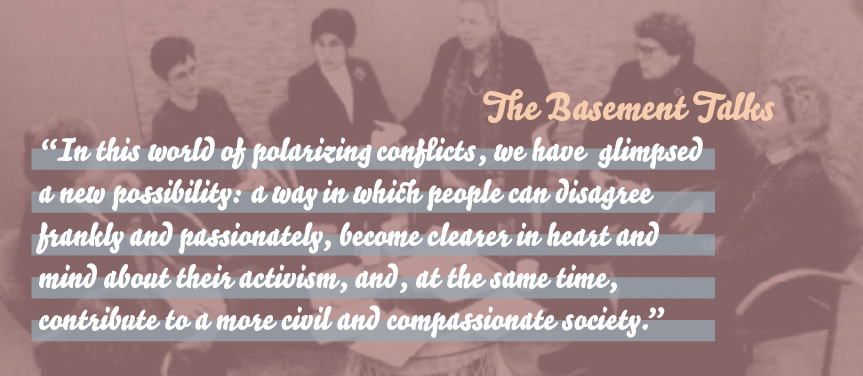
Image of women sitting in a circle debating, with quote "In this world of polarizing conflicts, we have glimpsed a new possibility: a way in which people can disagree frankly and passionately, become c learer in heart and mind about their activism, and, at the same time, contribute to a more civil and compassionate society.”

We recently co-directed our first film together. And we screened this film in Boston several months ago, the theater was packed. People there included past presidents of Planned Parenthood along with the current administration. A few rows back was the president of the largest pro-life organization in Massachusetts. Women who advised the Pope on abortion advocacy were in attendance. People who had seen friends gunned down in an abortion clinic shootings attended. There were pro-choice and pro-life activists—people who had protested and been arrested. These were people who really cared and desperately disagreed personally, politically, and publicly. 

They had come to see our film, The Abortion Talks (now called The Basement Talks). We don’t know, but we imagine this may have been one of the most politically diverse screenings of any film in history and certainly any film about abortion.

This story started with two murders. And then a whole court case. We interviewed the prosecution and defense attorneys. Both colorful characters. They talk about how the case became a media circus. The pro-chocie and pro-life movements trying to control optics, jockeying for publicity, and putting their spin on the story. And the case was never resolved because John Salvi was probably murdered in prison. That’s the story everyone saw. It’s a tragic story. It’s a true crime story. It’s a sensationalized story.  

But there’s another story. And it took place in a basement in Watertown. Three pro-chioce and three pro-life leaders began meeting secretly. I mean nobody knew about them. Fran Hogan, one of the pro-life women, would sneak off to these mysterious meetings and her secretary thought she was having an affair. These women met for six years, a total of 150 hours of conversation. And in the documentary you get to hear from the actual tapes, the actual conversations

Let me introduce you to some of these women.

Nicki Gamble was the president of PPLM. She opened the first Abortion Clinic in Massachusetts. She grew the organization from an operating budget of 200K to multiples of millions. Today, there’s an abortion clinic in downtown Boston named after her. But do you know what she says was one of the most important experiences of her life? It was talking with these six women.

Another woman was Barbara Thorp. She was arrested for protesting the Vietnam War. After the war ended, her anti-war sentiments were funneled into the pro-life movement. She became the director of the pro-life office of the Archdiocese in Boston. Later, she was appointed head of victim outreach after the Spotlight article shed light on pedophilia in the Catholic church. After that, she was appointed by the state of Massachusetts to lead the One Fund victim services following the Boston Marathon Bombing.

And one of the most profound moments of her life was eating cake. The six women had gone out to eat together. They’d finished the meal and the waiter asked if anyone wanted dessert. She says everyone wanted dessert but no one wanted to say they wanted dessert. But somehow, a dessert was ordered, and the waiter brought out a bunch of spoons. She describes partaking of that sweetness together, as a sacred experience. 

And perhaps, there are few things more Christian, than sharing bread, in this case, highly sweetened. Two thousand years ago, there was a similar event. Instead of women, the attendants listed are all men. Instead of cake, it is flat bread, broken, shared. And some wine, drunk. And of course the people. Friends, Jesus calls them. Traditionally, the seder was a family event. And this was the creation of a new family. The family of Jesus. His church. 

And they eat together. And then Jesus washes their feet. And Peter protests. Don’t wash my feet, he says. Because what else can you say when divinity not only sees your dirtiness, but starts to wash it away. And then Jesus gives his first commandment, the base layer of code for his new family. The bedrock upon which his church would be built. He tells his disciples to continue these two acts. To break bread together. And to wash each other’s feet. 

Let’s consider our involvement in this most foundational call. Who do we share bread with? Whose feet do we wash? 

As we consider this important question, we no doubt will come to the hard decision of where do we draw the line? Who do we welcome in? Whose feet do we wash? And who do we cut out? Do we call some people to repentance or conversion first? And what about the people who will never, ever agree with us, with whom compromise or common ground is actually impossible? It’s a hard question, one we have to answer ourselves because Jesus does not draw a line for us. Instead, he simply says do as I have done.

And who was at his table? The man who would betray him, had betrayed him already in his heart, yes, he was there. The man who would deny him three times, yes, he was there. The man who would not believe his resurrection, yes, he was there too. The family of Jesus, his disciples, the people who would build a church, tell his stories, create a movement. They would disagree passionately, dramatically, constantly. And yet they met together, and broke bread, and washed feet. And somehow, they persisted. Against all odds, they created a movement that overtook Rome. It spread faster and more completely across the world than any other religion. And how has it survived and persisted in the millennia since? How has it moved from culture to culture, from continent to continent, from race to race? 

I think the roots of its success can be traced to its origin. Which in a real way was the breaking of bread, and the washing of feet. But what is so powerful about sharing a meal, and washing some feet? And why eat with people who sin, or who are wrong, or who look or think differently? People who will betray you? People who will deny you to the world. Why include them in these sacraments?

How far can this charity go? Didn’t Jesus also say there would be wolves in sheep’s clothing? Aren’t we to project the flock? Ensure the integrity of our movements?

Yes, we ought to protect the flock. But I don’t think we do this best by being on the lookout for wolves we can exclude or call out or cut off. This was the approach of Captain Moroni, who was so infuriated with the atheistic beliefs of Amalickiah that he provoked a mob to chase Amalickiah out of the land. They banished him. And to what result? Amalickiah joined the Lamanites and raised armies and became much more dangerous than he’d ever been as a Nephite. That is the problem with rage. That is the problem with anger. Feuds grow, they do not resolve easily.

I think Jesus’ plan was more subversive and more effective. To protect the flock, Jesus gave us two rituals. Eat together. Wash each other’s feet. Because this is how we turn enemies into friends. This is how we preserve who we are without shrinking into unholy orthodoxy. This is how we continue to grow in particularly turbulent times. This is how we survive persecution. This is how we continue to remain relevant. Because we have these traditions and these rituals at our very base. Traditions that enfold people in, that build bonds of belonging. They heal wounds, they end feuds, they temper range, they ward off jealousy. They are traditions that don’t shrink from difference and are not scared by a few fangs.  

So how does this work? Let’s look at the women of The Abortion Talks and what they were able to accomplish together. And actually, what the women didn’t accomplish is perhaps as important as what they did. Each of the women who participated in the Abortion Talks independently said that this dialogue was one of the most important things they had ever done. And yet they did not come to common ground. They did not come to an agreement. They did not change each other’s minds. But they did change their opinions about each other. And in turn this changed everything. It changed how they spoke to the media. In fact, a random journalist in Boston who had no clue that these conversations were happening, wrote an article saying that opinions of abortion had not changed, but the rhetoric around the issue had. And how had it changed. Because six women were breaking bread together.  

Now imagine if that had happened with Moroni and Amalickiah. Would enemies be made friends? Would history have changed? Would thousands of lives been saved? Perhaps, perhaps not. But let us not underestimate the power of our founding rituals. 

And while they are powerful, they are not always easily done because you are not just gaining a friend but losing an enemy. One of the women of the Abortion Talks named Madeline explained it as an internal battle. Because she felt that what the pro-choice women were doing was evil. But after spending so much time with them, she couldn’t help to feel that they were well intentioned. And that was hard for her. Yet the struggle blessed her life. Later, when a member of her organization approached her with an op-ed, Madeline refused to publish it because it misrepresented the pro-choice position. 

This work is not easy. It takes some courage because you will realize that your enemy is not so different than you as you hoped. You both take baths and yet you both have dirty feet. This, I believe, is actually the most effective approach to purifying and protecting your movement. It might not kill wolves, but it makes them less dangerous. 

Why? Every time we screen this film, we get this question. Why bother talking with people who will never agree with you, who will never change their minds? After telling the story of the abortion talks, I see three answers. The first answer I came to was what it did for these women.

After six years of dialogue with their opponents, they reported feeling more comfortable, more confident, and more convinced of their opinions. And they spent most of that time talking about the very issues they disagreed about. And they called this a gift. They reported understanding themselves better as well as understanding the other side better. They reported being better leaders in their respective organizations. Each of them furthered their movements. 

And this was only accomplished because of the hard work of understanding their enemies as full bodied, intelligent, well-meaning, good people. If you do this work, you will realize that your enemy is not only like you in many of the best ways, but that you are like them in many of the worst. That is why Andrew Sidorkin believes that “Dialogue with mean others may be in many cases more important for our psyche than dialogue with a nice, understanding therapist.” 

That is why we must break bread with others. And we must wash feet, particularly the feet of those we disagree with. We must do this for ourselves and our own sake. It will reveal us to ourselves. It will keep us humble, meek, and pure in heart. Breaking bread and washing feet is the profession of peacemakers. This is how we inherit the earth. In an article they co-authored, the abortion talks participants wrote:

When we face our opponent, we see her dignity and goodness. Embracing this apparent contradiction stretches us spiritually. We’ve experienced something radical and life-altering that we describe in nonpolitical terms: ”the mystery of love,” ”holy ground,” or simply, ”mysterious.”

My second answer I’ve come to is that there is a long tail to real progress. A legal or legislative victory is only temporary. Whatever advancements you make while you have control of the white house, or senate, or court, can be undone when the parties are switched. Victims quickly become oppressors. Lasting victory only happens when we turn enemies into friends. Saint Francis did not quell the violence of the child-eating wolf of Gubbio by driving him out. Instead, he tamed the wolf by giving him food, and holding his paw.

But a peacemaking approach to activism does not just benefit us or our movements. And it will not always win us converts to our special causes. Because issues like abortion might never be resolved. This country has been split about 50/50 for over 70 years. Not much has changed. And if nothing is changing, why talk? Why meet? Why break bread? Why wash feet? 

I came to a third answer recently, listening to an amazing man who led reconciliation efforts in Guatemala after the war. To him, these types of conversations were not about obtaining some potential resolution to conflict. Democracy, he said, is and will always be full of conflict. We cannot eliminate it. But we must not ignore it. To preserve democracy we don’t need conflict resolution, but conflict control and conflict mitigation. And we must work hard to preserve human connections across our most intractable issues if we are going to prevent them from ruining us. 

Polarization in our country is quickly becoming our greatest threat. It won’t take another civil war, the damage has already started. We are becoming, as a society, addicted to rage in the same way someone becomes addicted to heroin. That’s why toxic polarization is what Peter Coleman calls A First Order Problem. That means it’s an issue that metastasizes into all the other issues. It renders us incapable of working together to solve basic human problems. Problems like healthcare, gun deaths, mass extinctions, poverty, etc. 

Just as polarization is a 1st order problem, breaking bread and washing feet must become a first order practice. It is the ground on which everything else is built or everything else falls. It’s the secret sauce to democracy. Learning to peacefully dialogue across difference is what allows a democracy to continue or what will lead to its downfall. It is how we turn enemies into friends, an outward reaching, inward growing motion. It is how we lengthen and strengthen the stakes of Zion. We do all this by never stopping, never relenting, never failing to practice our founding rituals. Breaking bread and washing feet.  

Let’s go back to that screening of The Basement Talks in Boston. When the film ended, there was a standing ovation. Pro-choice and pro-life leaders, activists, and pundits cheered together. They cheered the work these six women had accomplished. Everyone there was united for the first time in a long time. And that was something to see, because after all we have been through, we are still the United States of America. E Pluribus Unum!

Every student in this country or any democracy should know that there is a side of history that is hidden, kept secret, untold. It takes place in upper rooms and in basements. It is a corollary to activism. There’s a piece of democracy that doesn’t make the news very often. There’s a work of politics that is slow and long and hard to explain. But when you get it, it changes your life. 

And at some point, you will probably realize that your enemies are rarely to be feared. And for your health and for your church’s and your country’s health you must meet them as the full-bodied, well intentioned people they are. These are the people who will correct your assumptions. These are the people who will see your blind spots. These are the people who will expose you to yourself. What you thought was a curse might become your greatest gift.

This is not to say there is no risk and no stakes. They are not just to be overcome, but to be wrestled with. And they will dominate you at times. And you will be tempted to break the connection. But before you do, please know that our country, like our church, is held together by these connections. And that maintaining them just might be the most important thing you will ever do. 

———

All images from The Basement Talks

Watch The Basement Talks

The Basement Talks is available to watch now as a six part series on Amazon Prime, AppleTV, or Google Play.


watch the basement talks

Read “Talking with the Enemy”

After meeting for more than 150 hours, the women of the basement talks co-authored an article for publication in The Boston Globe. Every single word had to be agreed upon by all the women. It took more than two years to write.


read the article

We’d love to stay in touch!

Join our monthly newsletter to get talks, essays, sales, resources, and more in your inbox.

Sign up below!


join the newsletter

Posted on Leave a comment

Even a bad man can be good

Courtroom image with quote that says Sometimes a wolf is actually a lost sheep in wolf's clothing.

Zeezrom was a judge. His job was to keep everyone following the law. Because without the law, their city would fall apart. Imagine a city with no laws. People could steal and cheat and fight and you couldn’t do anything about it except fight back.  

Laws created order and security. For example, there was a law that said don’t steal. That wasn’t just a good idea or something that seemed fair. It was necessary for a city to exist. It allowed people to live side by side and work hard and earn money and build their homes without fear that all their hard work would be wasted and their home taken by somebody else. So laws kept cities moving, and building, and growing.  

But laws require law keepers. Because the moment the laws stops working or the people stop trusting each other, the whole system falls apart and people fight and cities are destroyed. And law keepers are known as judges. They make sure things are fair. And people don’t cheat. And laws are followed. 

And so when Alma and Amulek came into the city telling everyone that all these man-made laws were meaningless and the only laws that mattered were the laws of God, this made Zeezrom uncomfortable. And then Alma and Amulek started talking about Judges and authority. They said that judges were just pretend and their power was pretend and their authority was pretend. The only real laws were God’s laws and the only real power was God’s power and the only real authority was God’s priesthood authority. 

And this made Zeezrom upset. Of course the laws were not perfect. And judges were just people. They didn’t have any magical power bestowed upon them by some higher being. It was all man-made, like the city itself. But just like the city, it wasn’t pretend either. What judges did really mattered!   

Zeezrom worried what might happen if all the people started walking around believing that all the judges were usurpers of power and that the only laws that mattered were from heaven and the only justice was God’s? If people believed they were only accountable to God, people would start justifying all sorts of nonsense. I can take this woman’s dog because she doesn’t love it like I do. God would agree. Pluck, the dog would be taken. I can steal money from this child because the child’s father stole money from me. That’s fair, in the eternal sense. Swish, the money snatched. I can punch this man because he’s mean and that’s what he deserves. God will be on my side. POW, right in his nose.

It was too messy. Too prone to human weakness and self-centeredness. Zeezrom didn’t even think God was real. He was just a way for strong people to abuse weak people and so that weak people could endure it. Because some day, God would make it right. This was justice deferred. But Zeezrom was about justice now. People didn’t have to wait for justice or fairness or freedom until they were beaten, stepped on, robbed, trampled over, and dead. They could have it now. Because of the law. And because of judges who kept the law, like himself. 

And so Zeezrom decided to expose Alma and Amulek for the liars they were. He knew their type. They were normally after money. And so Zeezrom got all his cash from his safe and held it up. “Look here,” he said, “I’ll give you all of this if you admit there is no God.” He shook the money in the air and gulped a little. That was a lot of money. It must be almost $20,000. He really didn’t want to lose it. But he had a plan. If Amulek or Alma agreed and took the money, he’d show that they’d broken the law. Because one of their laws was to not trick people. 

It was okay to be wrong or disagree. But if you were intentionally lying to people that was a punishable offense. And Zeezrom could arrest the two men, put them in prison, and have his money back in his safe before they could say “Fire and brimstone.” But Zeezrom’s plan didn’t work out. Because Alma and Amulek didn’t take his money. They saw right through his plan and told everyone what Zeezrom was going to do. 

This was a little embarrassing mostly because they were right. And because his plan to expose them as liars was itself dishonest. And that was illegal. And it made him a liar. And while Zeezrom started to feel bad, Amulek started to preach about all the terrible things that would happen to liars. He talked about God and life and death and afterlife and after death. 

Amulek spoke passionately, fervently, honestly. And Zeezrom could see that this was not a liar. This was no trickster. What he was saying, he really believed it. And he was saying that no matter what, great women, handsome men, rich and poor people would all die and their bodies would decompose and turn into the same black dirt. That was its own kind of justice. But there was more. They wouldn’t just disappear. Their souls would continue and receive new bodies and they’d have to face each other and admit everything bad they’d ever done. 

But the justice was even deeper than this. They’d have to face God. And God would judge everyone. It sounded kind of terrible but also kind of great. Because as a judge, Zeezrom knew all too well how unfair the law could be. Good people lost cases. Loving parents were separated from children. People were kicked out of business. Others lost jobs. And while he tried to do what was right, the law was complicated. And people were complicated. And justice was an imprecise science. 

And something about the idea of a wise judge who could untangle all the knots, and write flawless laws, and enforce a perfect justice sounded like a beautiful idea. He wanted it to be true. And something in his heart allowed him to believe it for a moment. And as the thought stood there in his mind, it grabbed hold and would not let go. And instead of fighting or resisting, Zeezrom welcomed it in. 

And while Amulek continued to preach and rant and then Alma began to rant and preach and condemn Zeezrom’s disbelief, Zeezrom was already a believer. And rather than defending himself or hiding his face or running away, Zeezrom stood tall and admitted he’d been wrong. And he admitted his new belief in God and in some perfectly beautiful future justice. 

And humility like this is rare indeed. And so everyone was speechless. Was this another trick? Had Zeezrom gone crazy? What was happening? They waited, but no subtlety became evident. No secret plan materialized. Zeezrom was sincere. And so the other judges thought he must have been possessed. Alma and Amulek had invaded his mind and taken him over. Or maybe he was sick. Maybe it was hysteria. Maybe it was contagious.  And so the other judges and rulers of Ammonihah threw Zeezrom out of the city, and sent people to kill him with stones. And they gathered his wife and children and burned them in a big ugly fire.  

And Zeezrom ran away, sadder than he’d ever been. And not just because his children were gone or his wife was dead, though that was already more than he could handle. But it was made worse because he felt responsible. He’d worked the people up. He’d created the unholy deference to a worldly law that was necessary but so deeply lacking. His rhetoric had lit the fire. His misplaced belief in justice had stoked the flames. His failed trick had brought the crowd. And his final conversion ignited the mob. 

And Zeezrom grew sick with shame. His legs wobbled. His stomach ached. His head throbbed. He threw up his food and could not sleep. He wished he were dead, except he dreaded dying because he now believed that after death was more life. His shame would not end but only be magnified. He’d have to face his wife and children. And then he’d have to face God. And God would see him, and judge him. And Alma and Amulek had been quite descriptive of what God would do to him. Zeezrom would burn in his own fire. That would be just. The flames would almost feel good. 

And Zeezrom was so sick with shame he remained in his bed for weeks and then months. And people thought he would die. But then someone arrived in the town and asked to see him. The door was opened, and Alma removed his cloak and untied his sandals. And Zeezrom fell on his knees and cried. “Alma, he sobbed, “I’m sorry. God knows I’m so sorry. What have I done? What have I done? God’s justice is around the corner. Kick me. Spit on me. I welcome your rebuke. You must hate me for what I’ve done.” 

But Alma only wiped away Zeezrom’s tears and hugged him and kissed his cheek. “Brother,” he called him. The word was so beautiful Zeezrom gasped. And then Alma said the only words that could have possibly been even more beautiful: “You are forgiven.”

And Zeezrom wanted it to be true but it was impossible. How could God forgive something so terrible? And there were others involved. How could God grant forgiveness for what he’d done to other people? How was that fair or just?

But something in his heart allowed him to believe it for a moment. And as the thought stood there in his mind, it grabbed hold and would not let go. And Zeezrom was too tired to fight or resist or push it away. And so instead, he welcomed it in and believed.

Artwork by Honore Daumier

We'd love to stay in touch!

Join our monthly newsletter to get talks, essays, practical ideas for building Zion, helpful resources, and more in your inbox.

Sign up below!

Posted on 1 Comment

On loving my neighbor

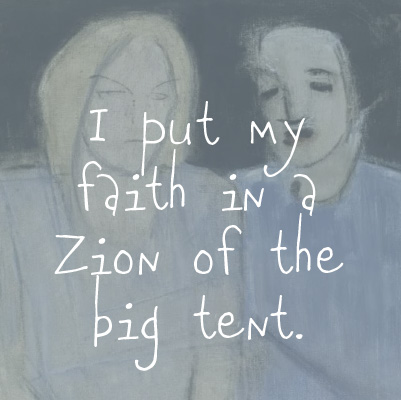
Painting of two women with quote "I put my faith in a Zion of the big tent."

I met Blanca when I was two months postpartum with my oldest, Clarence. We were living in Boston, and it had snowed a big, wet, New England bomb cyclone. My husband was away filming, so I strapped Clarence into the carrier, zipped him into my coat, and went out to shovel. I had cleared a small portion of our driveway when I heard someone above me shouting “Aren’t you the woman with the baby? Are you crazy? I’m going to tell your husband what you do!” 

It was Blanca, our neighbor next door. I loved her immediately. She came and helped me to shovel the rest of the driveway and one parking spot, then had me quickly move my car into it before any of the other neighbors could take it. A few weeks later on Valentine’s, we brought her a slice of strawberry cake as a thank you for her help. She became quite emotional accepting it. It was then that we learned Blanca was a widow. Her husband had died more than fifteen years ago while her children were still in elementary school, suffering a heart attack after shoveling snow. Little wonder she had been so stressed by a newly postpartum mother shoveling alone.

After that, we made frequent visits to Blanca’s home, stopping by for half an hour on Sundays normally to chat and show her our growing baby. Blanca was our first neighbor to learn about Clarence’s allergies when he was diagnosed. Every Halloween for the next three years, Blanca had a bowl for the trick or treaters, and a bowl full of treats specifically for Clarence. When I protested that she was too generous, she waved off my concern “I don’t know what he likes, so I just get some of everything.” Every Christmas, Blanca would purchase Clarence a new coat, a treat, and a toy, often police themed.

That’s because Blanca’s son Alex was a police officer. She told us the story of how he joined the force. It was Alex, she said, who found her husband’s corpse on the floor. Alex who called the police to report an emergency. Alex who saw police officers refuse to let his mother in to identify the body until she stopped crying. “You’re upsetting your kids,” they snapped at her. Alex determined that day to become a police officer, and to do the job better. And he did. I have so many memories of Alex sitting with Clarence on the floor, passing a toy car back and forth across the linoleum. He is a good man. A gentle man. He and his younger brother Jason were Blanca’s joy. Blanca’s refrigerator was plastered in pictures of friends and family, but her living room was a celebration of her children.


Then COVID hit. As the shelter in place orders were instituted and remained for months and months, our 600 square foot apartment began to feel claustrophobic. So we made a picnic table on a patch of dirt in the back. Blanca donated some wood to the project, with the stipulation that we must make a mini picnic table for Clarence as well. It was probably the most adorable thing we’ve built to date. 

It was from this picnic table the afternoon before a large protest was scheduled in downtown Boston that I watched Alex boxing alone outside, clearly very stressed. Riots had been happening, and relations between the police and the public were explosive. Blanca came out with a plate of dinner and entreated him to eat. There was an intense, silent communication between them, and then Blanca nodded, put the plate on a chair, and returned inside. What a mother wouldn’t do for her son, I remember thinking. She later wept as she told me she had never seen Alex like this. Work was so bad, and he was trying so hard.

But it didn’t slow her down. All through COVID, Blanca frequently brought us groceries which she had received after waiting in lines many blocks long at the Catholic Church. Blanca had temporarily lost her job during the lockdown, and these weekly grocery drops kept her afloat at the time. She didn’t have much then, but what she had she loved to share. I would sometimes bring her homemade bread. And so she asked if I could teach her how to make Pan Sobao, a Puerto Rican bread she grew up with on the island. We spent the afternoon in her small kitchen together. Blanca brought over half the loaf when it was baked, and made two more the next day. It was, she told me after, her first time making bread.

A year later in July, a few months after Cal was born, we met up with Blanca to see the Independence Day fireworks. We took a picture together, and I thought about how grateful I was for the good people we had met over the last few years. People we loved deeply and would miss profoundly when we moved. We walked home together, and Blanca greeted each of the police officers as we walked. They were Alex’s friends. Her friends. The familiarity was beautiful.


Two weeks later, after a false child abuse accusation was levied against Josh and me, some of these same police officers would appear on our doorstep at 1AM on a Saturday morning to take our children from their beds and remove them to foster care. I recognized them. I asked if they knew Alex. They did. I told them we loved Alex and his mother. We were neighbors, friends. We begged them to reconsider. To come back in the morning when our children would be less confused and terrified. We called Blanca. We thought if only they could see her, maybe they wouldn’t do this. Miraculously, she answered. She came out of her house at 1:30 in the morning and watched for an hour while our life became an agony. And then she held me as I sobbed into her chest. This is my friend Blanca.

I hope you’ll forgive the long introduction, but it is necessary for you to understand what comes next.

I’m flashing forward more than a year. It has been months since we won back custody, packed up our one bedroom, said our tearful goodbyes to Blanca, and left her with a bread maker to remember us by. Months since our big adventurous move to rural Idaho. We have found a law firm and filed a lawsuit against the individuals involved in the removal of our children. The hope is to change policy. To set a precedent that you can’t show up with armed law officers and no warrant or paperwork and demand someone’s children. It is an important cause, I think. The change will offer protections to families far less fortunate and resourced than ours. And it’s a big case. It reaches headlines in national newspapers. 

Blanca sees these headlines, but she hears the news first from her son, Alex. His friends are listed as defendants, and he is worried for them, unsure what the lawsuit will mean for them personally and professionally. Blanca calls me. She says she does not understand. The police, they were just doing their jobs. Alex could have been there. His friend were there. Blanca’s friends. What happened was wrong, but surely this was wrong too? I hope you can see the goodness in her perspective. I can, even as I believe completely in the importance of our lawsuit.

I did my best to respond, but the end of the conversation felt like a death to me. I knew I would not hear from Blanca again.


This is my story but I do not think the experience is unique to me. All of us have and will find ourselves at odds with other people. Good people. Even people we love and who love us. Sometimes it’s a simple misunderstanding set right with better communication. Usually, the situation is more complicated.

Often, conflict is much more complicated than someone’s sin or moral failure. Usually, it isn’t as simple as who is right and who is wrong. Frequently, it arises out of complex situations with competing goods and competing approaches of doing and achieving good. The remarkable and difficult to stomach reality is that most people, most of the time, are not trying to harm each other. Most people, most of the time, are trying to be good. That is true of you, it is true of me, and it is true of the vast majority of people we dislike, people we disagree with, people we are in conflict with. Faced with the reality of other people, we remember that the purpose of life is not to be correct, but good.

I was reminded of this late last night when we were driving back from UT with a trailer we had just purchased off Facebook Marketplace. The trailer blew a tire. We pulled off the highway and tried to figure out what to do. We weren’t sure we’d be able to replace the trailer tire with our car’s spare. There were some men noisily occupying the street parallel to us, so Josh went over and asked if they might be able to help us. The men were obviously drunk. They had a flag with an expletive hanging outside their house. Their speech slurred. They made graphically inappropriate jokes. I didn’t like them. But they helped us. They lifted the trailer by hand. They removed the shredded tire. They attached the spare. And then, completely unprompted, they apologized. They were helping us, and they apologized several times for being drunk, for swearing, and for being a redneck. One of them said “You know, my dad was a bishop and my mom was a relief society president, and now look at me.” There was a real shame behind that admission. It surprised me. The human desire to do and be good always surprises me. 

I care a lot about peacemaking and depolarization. But in reality, in my actual interpersonal interactions with people, I find I am painfully and unattractively bad at it. As Dostoyevsky writes, love in action is a harsh and dreadful thing compared to love in dreams. 

I get defensive. I get tribal. I blanch, I bristle, I retrench. And all of this is very human, and understandable. And all of it comes, I think, primarily from a place of fear. Fear that this thing that I care so much about is being harmed, or that this issue I feel passionately about is being dismissed, or that this world view I’ve developed isn’t welcomed, or that this person I love will not love me past this disagreement.


But the message of Jesus is peace, and love. And love is the height of vulnerability. Love requires us to look at our fear and have conversations with it. And we can’t do that until we are willing to look at each other, because we are the embodiments of each others’ fear. The people we disagree with are the embodiment of the thing we are terrified of and we will continue to react fearfully towards them until we finally trust enough in Jesus’ grace and God’s love for us and for them to face each other and talk. Talk together until we begin to see each other as humans again. Friends. Good people. Children of God.

If we want to make our church a place where love can flourish, where we can raise our children to carry on Jesus’ work in our chapels and neighborhoods and communities, we have to learn how to disagree, and how to de-escalate disagreement from a place of fear to a place of vulnerability. Because love is not just thinking nice thoughts or having nice feelings. The depth of love requires us to look directly at fear, expose our deepest vulnerabilities, and carry them together as a peaceable community of Christ. This is how love casts out fear.

I have found that disagreement is an inevitability in any community. Rather than allowing differences and disagreements to become a wedge driving us apart, let’s use them as an opportunity to open difficult, necessary, respectful conversations across differences. Let’s allow each other to disagree, frankly and passionately. Let’s talk about those disagreements vulnerably, without strawmanning or calling each other names, or walking away from each other or from our pews entirely. And, at the same time, let’s work together to build a civil and compassionate community, anchored together in the love of Christ, the Prince of Peace. 


Shortly before Christmas, we received a package. It was from Blanca. Inside were two new coats for our boys, a matchbox police car, a Paw Patrol siren headlamp with sound capabilities that we discovered exactly five seconds after Clarence did at 5:30 the next morning, too many dairy free treats, and this note:

Dear Clarence, Cal, Sarah, and Josh,

I hope the coats fit the boys. I don’t know what size they are now. They must be so big. Tell Clarence I miss seeing him and hearing him play and ride his bike. I hope you are all happy in your home and that you have a great, happy Christmas. We miss you all.

Love,

Blanca, Alex, and Jason

PS Have also a Happy New Year.

I am forever grateful for my friendship with Blanca. She has changed me, not just by being kind, but by being vulnerable. By her willingness to disagree honestly, frankly, passionately, and her charity and fortitude to continue a relationship anyway.

I believe in Christ’s promise “Peace I leave with you, my peace I give unto you: not as the world giveth, give I unto you. Let not your heart be troubled, neither let it be afraid.” I believe that there is no fear in peace, but peace is also not the absence of disagreement. Peace is loud. Peace is work. Peace is the result of good people working and loving and maintaining relationships even when compromise seems out of the question and when returning to the tent again, and again, and again feels impossible. I see it happening day in and day out throughout the world. Remarkable people, quietly doing good, choosing again to be vulnerable. 

I put my faith in a Zion of the big tent. A Zion where all sorts of people can live together, and disagree together, and work together, and make peace together, and build God’s kingdom on earth together.

All artwork in this post by Helene Schjerfbeck.

We'd love to stay in touch!

Join our monthly newsletter to get talks, essays, practical ideas for building Zion, helpful resources, and more in your inbox.

Sign up below!